
Happy New Year, I guess.
What are your good resolutions? Mine? To write more, hehe. And OKAY, I’m a bit late, but trust me, I wanted to write this article for MONTHS, the TARTAN is clearly back. I am so sure of myself, I should maybe become a trend researcher? Or a trend predictor? Is it too much ego if I say a trend setter? Yes, I’m figuring out my life. I have to find a job (my studies are coming to an end). I’m currently writing this article (finally) to avoid writing my thesis. I call this behavior « balance of duties ». Anyway, the girl is stressed about her future and she is searching for her path. But before having a mental breakdown mid-editing, I’ll tell you about this MAGNIFICIENT pattern. First, a bit of history…
WELL, if you don’t know it, you surely live in a cave. Tartan is as old as your greatgreatgreatgreat…grandmother (I was too long to write 60 times the word « great », but you get it, the pattern is old). Indeed, the first traces of the pattern date back to the 3rd century in Scotland. Then, succeeded a lot of centuries were the checkered pattern was derived into multiple variations and serve as an identifier for clans in the Highlands of Scotland. In the late 15th century, the great kilt was created with Tartan (a longer version of the modern kilt we all know). Even though Tartan patterns were different, the meaning was the same. It was a symbol of identity, pride, courage, and loyalty. Not to mention, since Jacobite rising, it has become a symbol of rebellion because mankind cannot live in peace. On a random day of 1746, the British government passed the Dress Act, which completely banned the culture of the Highlanders and their beautiful little tartans, what a world. Not to go into too much detail since I’m not a specialist in the Jacobite rising, the only thing I realised is that a reckless and impulsive man failed (again). In 1782, the Dress Act was repealed, finally. However, it is only 60 years later that Queen Victoria (yes, a woman) romanticized this once-banned culture and started to fall in love with the Highlands. Why would it be ok? Well, simply because Scotland was not seen as a threat anymore from the British government since Highlanders became landlords and not clan leaders. Indeed, a culture was changed, but the core values of the Tartan remain. Taking a big leap in time, we can thank another woman, Vivienne Westwood, and the punk revolution, for promoting and maintaining the rebellious mindset of Tartan.
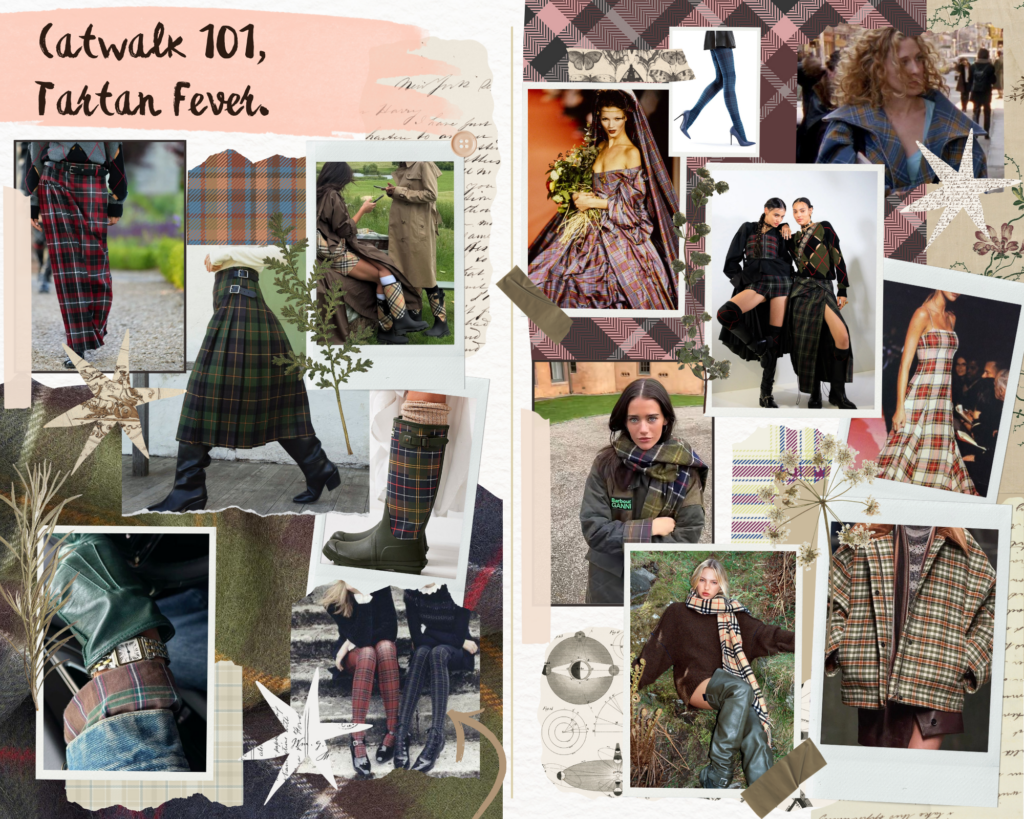
On a softer side, this complex-weaved pattern is now protected thanks to the Scottish Tartans Authority (yes, it exists and the headquarters is located in Crieff, I’m not kidding). It was founded in 1996 and maintains a database (of the International Tartan Index) containing more than 4000 tartans. Anyone can register their own design, but it does not imply trademarking. And in case you were wondering: no, fast fashion companies neither trademark nor register the patterns they use. However, you surely know who did, and you don’t need a 3000 euro trench coat to have seen it. Indeed, Burberry has its own pattern, « the Burberry » or « the Nova » or « the Haymarket », whatever it is, the name of their famous beige, black, white, and red check. My personal favorite Tartans are the Barbour’s. The brand did not trademark them, but they own multiples for their brand image with more traditional, darker colors such as olive green and navy blue. I link them to this slow cottage life, effortless and cozy aesthetic (not me romantizing the movie « The Holiday ») that contrast with the bright yellows and reds of the punk aesthetic.
Overall, Tartans have a rich heritage and great core values. Last year was polka dots, and in 2024 it was leopard print (still love them though), but 2026 is the Tartan, trust me. Dior has shown it in their Cruise Runaway 2025 while paying a tribute to Scotland, and now, the world is shedding light on it. Wear it as a main statement jacket or hide it through details. There are so many different ways to integrate it into an outfit. My favourite? the tiesssss, of course the ties. I rarely wear ties, but omg idk what is going on with colored and patterned ties (we will come back to it in a following article, I’ll investigate).
Anyway, I hope you liked this history lesson, and you are feeling rebellious to start wearing tartan. On my side, I bought (a year ago) brand new Hunter rainboots (on Vinted, obviously) and I’m excited to wear them in a cottage (idk when or where but it is on my vision board 2026).
See you next class,
Fanny ;))